
escort diary® of Jolie: The room you walk into
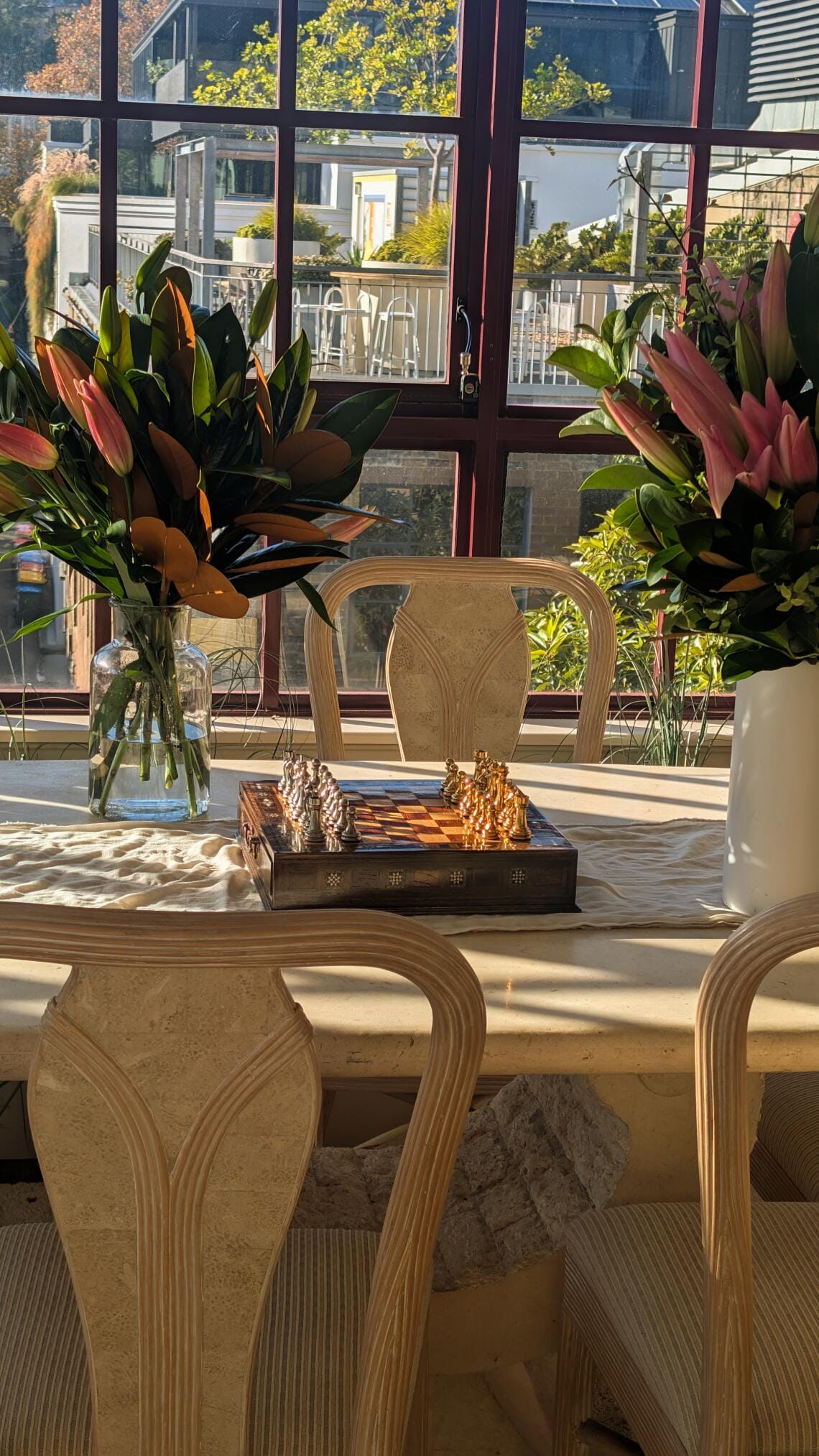


My apartment is not styled.
It is not decorated, it has not been assembled from a catalogue or curated by someone whose job title contains the word interiors. It has been built, slowly, accidentally, one found object at a time, over years of living in a city that leaves beautiful things on the kerb if you know when to look.
The dining table came from an antique shop in Melbourne, a rare piece for a steal of the price, so affordable I paid immediately for it without reading the fine print that delivery wasn't offered. Solid travertine, slightly scarred, the kind of surface that has clearly survived years of meals and arguments. I wasn't looking for a table that day, I was looking for a bookshelf.
This is how most of my furniture arrived. Not through planning but through recognition: the sudden, physical certainty that a thing belongs with me, which I realise sounds like how people describe falling in love and I am not entirely sure it isn't. The armchair was a "I'm going to buy the birds food and Oh! would-you-look-at-that-a-vintage-furniture-warehouse" find that I fell in love with immediately. It's from the 40s, has serpentine wood, and squeaks when you sit back. It smells like history.
The mirror in my bedroom that my chinese friend abhors because of the Feng-Shui was found on the side of the street, so did the writing desk that I forced my neighbour to help me carry up (with how many pastries I've baked for the building, I am owed). The eggchair was a facebook marketplace steal so good I felt horrendous for the man who offered to deliver it to me for free and ended up having tea with him for over two hourse.
The lamp was a piece of driftwood I may or may not have taken from the Royal National Park after an 8 hour hike covered in thick jute rope and vintage Eddison bulbs, crafted over several months of love and care.
And then there's the camphor trunk in my bedroom that smells like my childhood. A carved, 180 years old Chinese trunk where I keep my sheets so they absorb the scent of the resin.
I am telling you this not because I think you care about my furniture, although you might, and if you do, we will get along, but because the space you walk into when you visit me is not an accident... it is an accumulation.
Every object in it was chosen, or found, or restored, or carried home by a woman who believes that the environment you put a human body in determines what that body is capable of feeling.
This is not a theory. It is something I know from experience, both professional and personal. I have been in beautiful hotels that felt like nothing: expensive surfaces, impeccable taste, the emotional temperature of a showroom.
And I have been in tiny apartments with peeling paint and one good lamp and a bookshelf that told you everything about the person who lived there, and those rooms felt like something. Like a specific someone had pressed their life into the walls and the walls had absorbed it and were gently, quietly radiating it back.
I built my home, slowly, to be the second kind. The kind where you walk in and something in your chest loosens before you've consciously registered why. Not because it's impressive, it is not trying to impress you.
Because it's coherent.
Everything in it belongs together the way the instruments in a good orchestra belong together: something that will give you the music of who I am as a person.
The warehouse windows are the thing people mention most. They are enormous, industrial, the kind of glass that was never meant for a home because the building was never meant to be one, the kind that let the freezing winter air in and make me feel like a plant in a greenhouse every summer. They let in the sort of light that makes everything in the room look slightly more alive than it did a moment ago, that particular Sydney light that arrives in the early morning like an uninvited guest who turns out to be the best part of the day.
I have arranged the entire apartment around what those windows do at different times of day. The sofa is where it is because of what the 8am light does to that corner. The bed faces the direction it faces because of what the top of the tree looks like when I wake up. I am not exaggerating when I say that the light is a piece of furniture in this apartment.
It has a position.
It has a function.
It changes the room every hour and I have never once gotten used to it.
There is a philosophy underneath all of this that I don't usually articulate because it sounds pretentious when you say it out loud and I would rather you just felt it when you walked in.
I believe that second-hand objects carry something. Not in a mystical sense, I am not going to tell you that my armchair has an aura, I mean that an object that has been used, lived with, touched daily by someone else's hands, has a quality that new objects don't.
It has been tested, it has survived, it has already proven that it's worth keeping, because someone kept it, and then it outlasted them or their need for it and ended up on a kerb or in a warehouse or in an op shop waiting for the next person to recognise it.
This is, I have come to realise, the same thing I see in people.
In the sense that what I do in my work, how I look at people in my life, what gets my attention, the thing underneath all the other things: what is already there.
I don't try to make anyone into something they're not, I don't perform a fantasy of who they could be on their best day with better lighting.
I look at who actually walked through the door, with their nervousness and their history and their particular, specific, unrepeatable way of being human, and I find the thing in them the scratches, the tears, the beauty that has kept and grown for years or decades.
And I treat it the way I treat the table: with care, with genuine attention, without trying to erase what came before, because those are my favourite parts.
My home reflects this.
Not because I designed it to send a message, I designed it because I like beautiful things and I am too stubborn and too fond of a good deal to buy them new (have you seen the price of good furniture now? It's this or plastic that will break when you sit on it).
But the effect is the same.
You walk into a room full of objects that have been found, chosen, restored, and arranged by someone who pays a specific kind of attention to the world, and that attention is in the air. You can't see it. But your body registers it the way your body registers temperature, not as information, but as feeling.
It wasn't on purpose, it was just attention, and a fondness for lived things and people.
But they look the same from where you're sitting.

