
escort diary® of Jolie: On writing by hand. (And everything that makes it better)
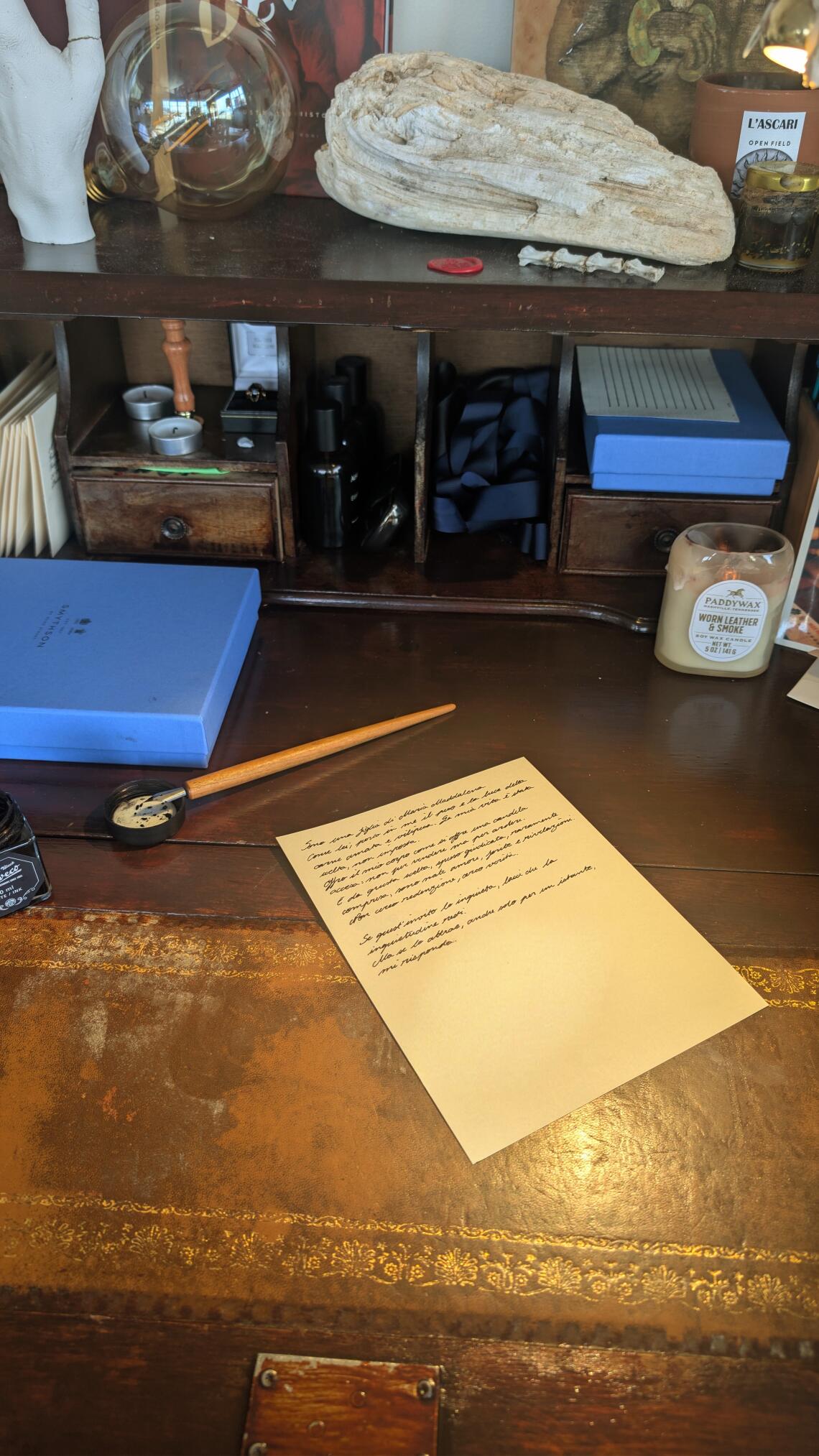


There is a particular kind of person who still writes by hand and I am one of them and we are, as a species, honestly a dying breed.
I need to be upfront about this: what follows is an essay about pens and paper and wax seals and if you are not the kind of person who finds these subjects worthy of sustained emotional investment then we are about to part ways for approximately six thousand words and I will see you next week when I write about something more accessible, like chocolate or heartbreak.
For everyone still here: let’s talk about nibs.
I own a wooden nib holder. It is not a pen in the modern sense: it is a handle, carved from wood, into which you slot a steel nib that you dip into ink. It is, technologically speaking, the same writing instrument that people used in the nineteenth century. It has no cartridge, no converter, no mechanism of any kind. It is a stick with a piece of shaped metal on the end of it, and it requires you to pause every few lines to re-dip, which means that the act of writing with it is not continuous but rhythmic: write, pause, dip, write, pause, dip, and that rhythm changes the way you think in a way that I have never been able to achieve with any other instrument.
A ballpoint pen is a machine for recording thoughts... a dip pen is a machine for slowing them down. The pause, the re-dip, is not an interruption. It is a breath, the small, forced gap between one thought and the next, during which your hand is occupied with the ink and your mind is left, briefly, unoccupied, and in that unoccupied moment something happens that does not happen when you’re typing or scribbling without interruption: the next sentence arrives better than it would have. Not because you planned it, but because you gave it room. The pause is where the thinking happens.
The writing is just where the thinking lands.
I want a black and gold fountain pen.
Not mandatorily gold gold (although...). The Parker Sonnet is one of the pens I keep returning to: it is not the most expensive pen in the world, not the most prestigious, does not have the cult following of a Montblanc (which is funnily enough where I'm from) or the niche credibility of a Sailor or the Japanese engineering mystique of a Pilot. What it has is proportion. It is a pen that looks exactly like a pen should look: not too heavy, not too slim, not trying to reinvent the form or challenge your assumptions about what a writing instrument can be. It is, in the best possible sense, classic. Which means: it was right when it was designed, and it has had the intelligence to not chase trends since.
The Pilot Custom 823 is the other pen I keep circling. This one is different: it is a pen for people who care about what happens when nib meets paper in a way that borders on spiritual. The 823 uses a vacuum filling system, which means it holds an enormous amount of ink, which means fewer interruptions, which means longer stretches of unbroken writing, which means, and this is the part that matters, the flow is different. A pen that doesn’t run dry changes your relationship to the page. You stop worrying about the ink. You stop monitoring. You just write, and the pen keeps up, and the feeling of a nib that keeps up with your thinking without faltering is the closest thing I have found to the feeling of a conversation with someone who actually listens.
I use black ink, and only black. I know there is an entire world of ink colours: the burgundies, the forest greens, the midnight blues, the inks that shade and sheen and shimmer and do things on paper that would make a watercolourist weep.
I respect these inks, and I admire the people who collect them. I am just not one of those people.
I use black ink because black lets the thoughts (and my determined cursive) and words be the focal point, without frills, without fanfare, and with a touch of serious that I bring in everything I do.
The paper. Smythson, always, forever Smythson.
I am aware that this sounds extravagant, and it is extravagant, and it's genuinely one of those small joys in my life. Paper is the surface on which your thoughts become physical, and the quality of that surface determines the quality of the experience in a way that people who have never written on good paper cannot understand until they do, and then they can never go back, which is exactly what happened to me, and I am not sorry.
Smythson paper is cream. Not white... cream. The distinction matters the way the distinction between a white wall and a warm wall matters in a room: white is clean and clinical and makes everything on it look displayed. Cream is warm and quiet and makes everything on it look placed. Black ink on white paper is a document... but black ink on cream paper is a letter. The warmth of the paper softens the authority of the ink just enough that the result feels personal rather than official, intimate rather than formal, written rather than produced.
The weight of Smythson paper is the other thing: it has substance. You feel it between your fingers the way you feel good linen: not heavy, but present. It does not buckle under wet ink, does not feather, does not bleed through, receives the ink with the quiet composure of a surface that was made for this specific purpose and knows it, and the nib moves across it with the particular smoothness that only happens when paper and ink and nib are all in agreement about what is happening, which is: something is being made. Not typed, not tapped, but made, by hand, with materials that are older than electricity, in a process that has not fundamentally changed in five hundred years.
And then the wax seal.
I have a custom wax seal: a simple octopus design. Which is stamped on wine dark red warm wax, the colour we usually see in antique European writings... or on bottle of wines. The process of stamping my letters with a small part of me feel the same as dipping my nib in ink: it slows me down at the end of my writing, helps me appreciate the craft, breathe and stay present in the moment, for just a little while longer.
If you have never received a handwritten letter on good paper, sealed with wax, written with a fountain pen by someone who chose every one of those materials deliberately, I hope you do. I hope someone takes the time. I hope the envelope is heavy in your hands and the seal cracks cleanly and the paper smells faintly of something you can’t identify and the handwriting is imperfect and alive and you read it slowly because nothing about it invites speed.
And if nobody does it for you, just send me an email and we can arrange that. I’ll write you one. Not the same day... later. After the evening, after I’ve had time to think about what I want to say. It will arrive in a Smythson envelope, cream, sealed in wax, written in black ink with a nib that I chose for the occasion.
It will be the slowest form of communication available to a human being in the twenty-first century.
It will be worth the wait.

