
escort diary® of Jolie: On muscle cars (and the men who love them)


I have a confession that does not fit the rest of my aesthetic and I am going to make it anyway: I am in love with Ford Mustangs.
Not the new ones, I need to be very clear about this because the distinction matters. I mean the old ones, prre-1973, the ones that were built in a factory by people who understood that a car is not a transportation device. A car is a statement, and the statement the early Mustang was making was something along the lines of: I am loud and I am beautiful and I do not care about your fuel economy and you will hear me before you see me and when you see me you will stop what you are doing.
I adore them, in the specific, slightly irrational way that I love everything I love: not from a distance, not with the polite appreciation of someone who "likes cars," but with the gut-level, physical, slightly embarrassing response of a woman who will stop dead in the middle of a footpath because she heard an engine note from 1969 and her entire nervous system just rearranged its priorities.
I cannot fully explain the appeal except to say that a pre-73 Mustang does something to me that almost nothing else in the designed world does: it makes me feel like someone cared. Not in the modern, optimised, focus-grouped way of caring, where every curve has been wind-tunnel tested and every surface has been approved by a committee. In the older, more reckless way, the way where someone drew a line and said that's the line and the line was aggressive and impractical and slightly insane and they built it anyway because beauty was more important than reason and power was more important than efficiency and the car was going to be felt, in the chest, in the teeth, in the part of your body that responds to things before your brain has had time to form an opinion.
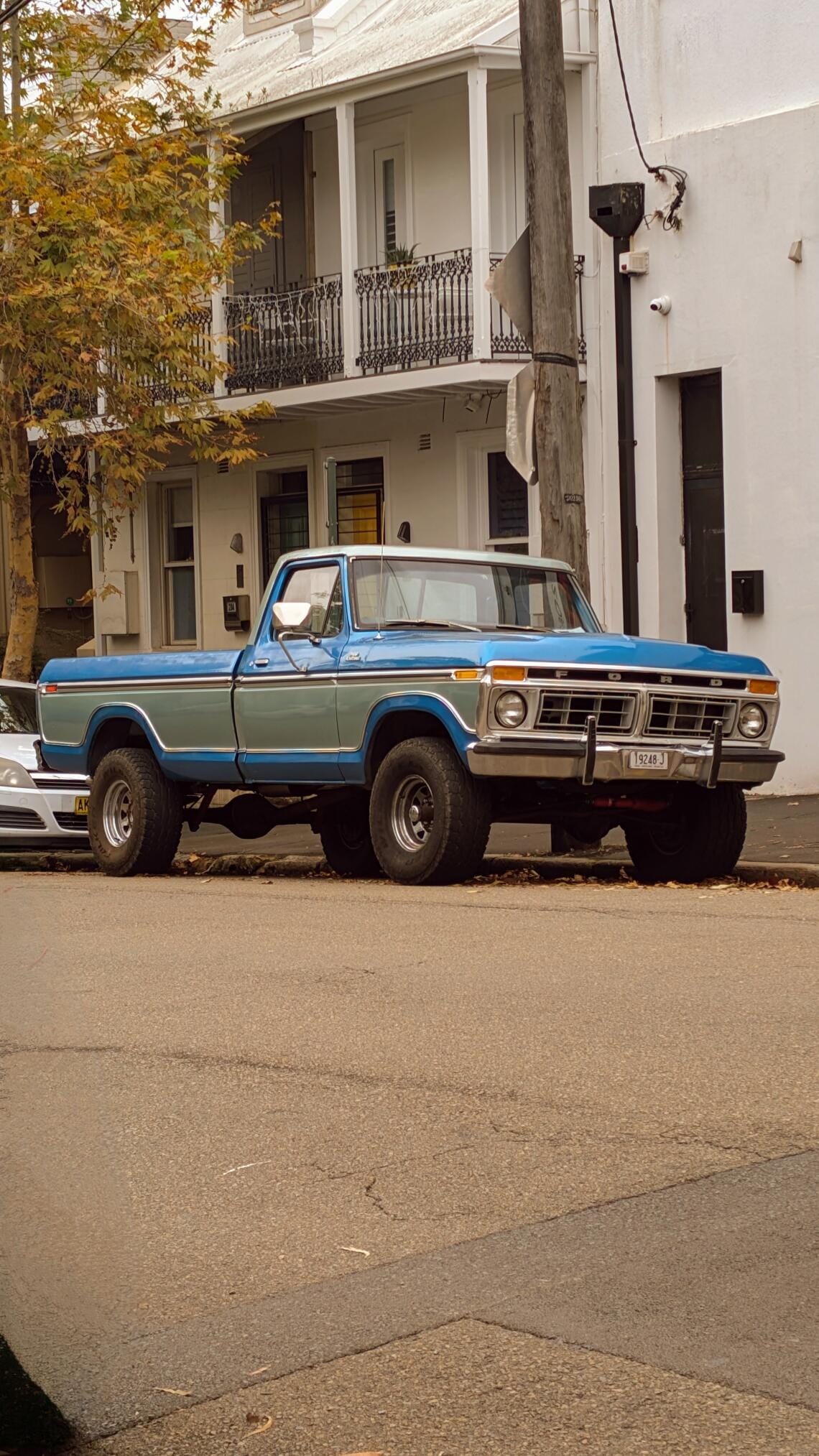
The pickups are a different love but it comes from the same place.
An old Ford pickup, restored to impeccable condition, is one of the most fascinating piece of art to me. It was built to work, it was built to be useful, it was built with the assumption that beauty and function are not enemies, that a thing can haul timber and look magnificent doing it, and that patina is not damage but evidence. Evidence that someone drove this thing hard and loved it and kept it running and now restored it because getting rid of it would have felt like a betrayal.
I think this is what I actually love. Not the cars themselves... though I do, genuinely, unreasonably, but what the cars represent, which is the idea that some things are worth maintaining even when they are impractical, expensive, inconvenient, and completely unnecessary.
Nobody needs a 1966 Mustang Fastback.
The roads don't need it, your commute doesn't need it, your bank account is actively hostile to the idea, the parts are hard to find, the fuel consumption is comical, tomething will always need fixing. It is, by every rational measure, a terrible decision.
And that is exactly why it matters.
Because a person who keeps a '66 Mustang alive is a person who has decided that not everything in life needs to be optimised. That some things exist not because they are sensible but because they are worth the trouble, that the correct response to a machine that is beautiful and difficult and demands your attention and your weekends and your patience is not to replace it with something newer and easier but to keep showing up with a wrench.
This is what I mean by a passion project. Not the Instagram version, not the curated restoration montage with the before-and-after photos and the sponsorship from a tool company.
I mean the real version: the garage version, the one where a person spends months tracking down a specific part from a specific year because the wrong part would work but it wouldn't be right, and the difference between working and right is the difference between a car and their car, and they can feel the difference even if nobody else can see it.
I find this impossibly attractive. Not the car (... well not JUST the car), the devotion.
The willingness to pour time and money and expertise into something that will never pay you back, that will never be finished because there's always something else to adjust, that exists purely because you decided it should exist and you were willing to do the work to make it so.
I know men who have spent years restoring a single car, decades, even. They talk about it the way poets talk about a poem they can't finish, the way someone enamoured talks about their lifelong partners: with love, with frustration, with the particular combination of obsession and tenderness that only exists when someone has committed themselves to a project that is simultaneously the best and worst decision they've ever made.
They know the car by feel, they know every sound it makes and what each sound means, they know which rattle is cosmetic and which rattle is structural, they have a relationship with this machine that is, and I do not say this to be cute, genuinely intimate: built on attention, on patience, on the accumulated knowledge that only comes from having your hands inside something for long enough that you understand it better than you understand most people.
I think there is something quietly radical about choosing to love a difficult thing in a world that has made ease the highest value. We are surrounded by objects designed to be replaced or become obsolete far before they should: phones that slow down after two years, furniture that isn't meant to survive a move, clothes that disintegrate after a season, relationships that blow up the moment something gets hard.
Everything is disposable because disposability is profitable, and the message, repeated so constantly that we've stopped hearing it, is: when something gets old, get something new. A person who looks at a fifty-year-old car with rust in the wheel arches and a transmission that needs attention and says no, I'm keeping this, I'm going to make it beautiful again is refusing that message. They are saying that age is not obsolescence. That difficulty is not a reason to leave.
That the thing with the most history is often the thing most worth saving.
I identify with this more than is probably reasonable.
I am a woman who restores second-hand furniture and feeds birds that don't belong to her and writes formal verse in a century that has mostly abandoned it. I understand the impulse to keep alive the things that the world has decided are finished, I understand the stubbornness required to maintain something beautiful when everyone around you is replacing theirs with something more convenient (if you've heard of my manuscript, you know how seriously I live by that), I understand the quiet, private pride of running your hand over a surface you restored yourself and knowing that the beauty you're looking at exists because you decided it should.
And I find it deeply moving.

