
escort diary® of Jolie: On books
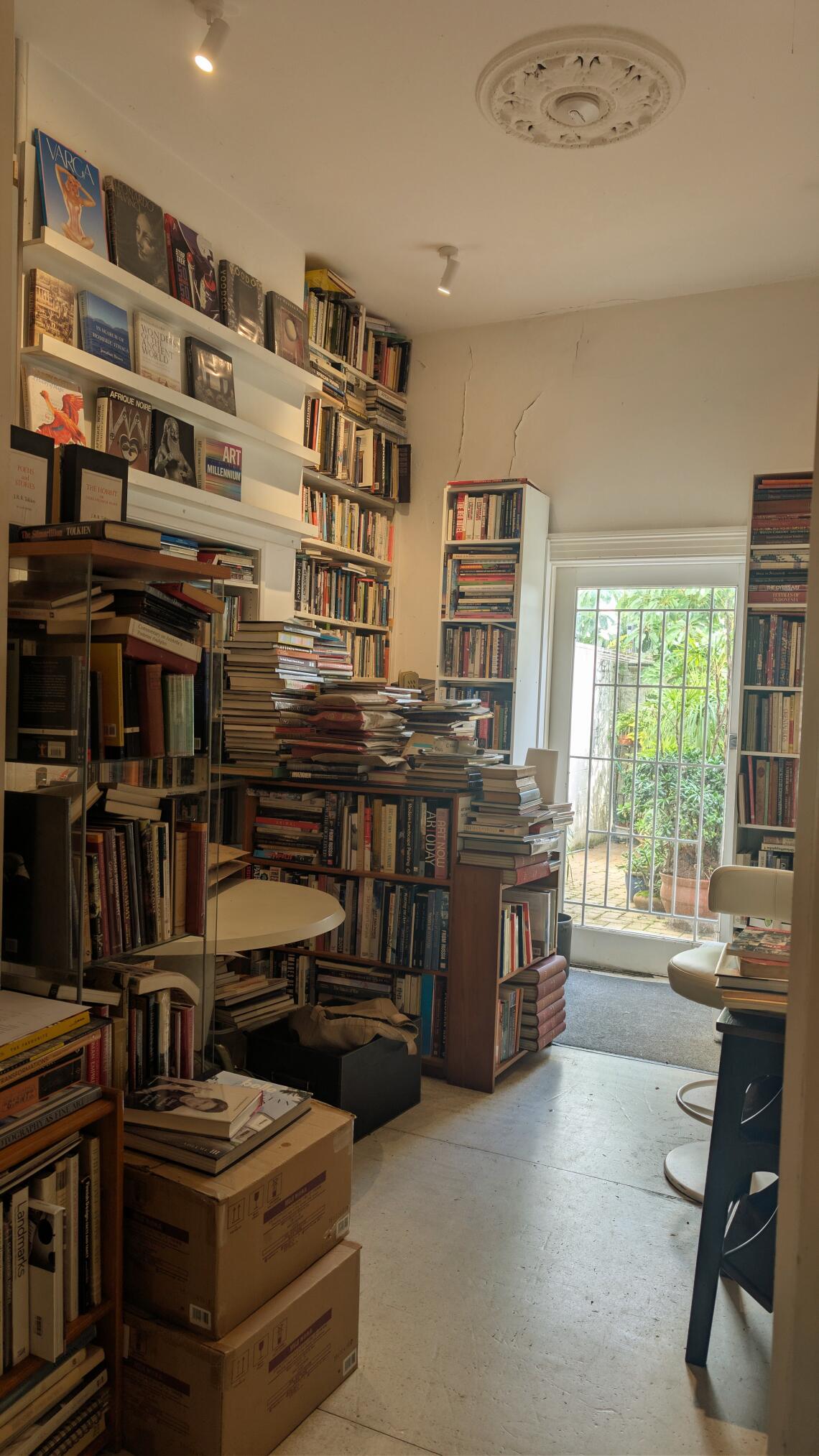


A client once looked at my bookshelf and said, very quietly, as though he was realising something he hadn’t planned to realise: “You actually read all of these.”
I wasn’t sure what to do with the emphasis on actually. I actually read them the way some people actually run marathons: compulsively, painfully, with no clear reward except the knowledge that I am different afterward than I was before, and with a strong opinion.
My bookshelf is the most honest thing in my apartment. More honest than my face, which I can manage, more honest than my conversation, which I can direct. The bookshelf just sits there, displaying every intellectual obsession I’ve ever had in the order I happened to shelve them, which is no order at all, which means Rilke is next to the poetry of Till Lindemann and Bataille is leaning against a paperback of Pride and Prejudice I never finished and keep because throwing away an unfinished book feels like abandoning someone mid-sentence, no matter how much I cannot stand English lit.
I am going to tell you what I read. Not what I say I read at dinner parties: what I actually read, what I return to, what has left permanent marks on the way I think and feel and see other people. This is more intimate than anything else I’ve shared in this diary, including the parts about my body, because my body is a thing I inhabit and my reading is a thing I chose, and the choosing is where the real self lives.
Maupassant first, because he is the one I love most and the one I talk about least, because the love is difficult to explain without sounding like I’m confessing something.
Guy de Maupassant wrote short stories in nineteenth-century France and he wrote them with a precision that I find physically moving. I mean this, there is a sensation in my chest when I read Maupassant that is closer to the feeling of hearing a perfect piece of music than to the feeling of reading prose. His sentences are engineered. Not in the cold sense, but in the sense that every single word is load-bearing: nothing decorative, nothing performative, nothing there because it sounds literary or because a lesser writer would have thought the sentence needed more furniture. Maupassant’s sentences are rooms with exactly the right number of chairs, and you sit down and the room works and you don’t notice the design because the design is invisible, which is the highest compliment I can pay any artist in any medium.
He wrote about ordinary people. Prostitutes and soldiers and farmers and wives and bureaucrats and the small, devastating cruelties they inflicted on each other in the name of love or propriety or survival. He wrote about sex without titillation and death without melodrama and money without moralising and he did all of this in stories that were sometimes eight pages long and contained more truth about human behaviour than most novels manage in three hundred. He is the reason I believe that brevity is not the enemy of depth.
Rilke you already know about, because I have been quoting him in this diary like a woman who has no other poets, which is not true but feels true because Rilke does a thing that no other poet does for me: he makes loneliness beautiful without making it comfortable.
He does not console you, he does not tell you it will be fine. He tells you that your solitude is the most important room you will ever live in and that you should furnish it carefully and that the work of being alone is work, real work, the kind that changes you if you do it honestly instead of just enduring it.
Georges Bataille is the writer I recommend to people I want to scare slightly, which is a larger percentage of the population than I should probably admit.
Bataille wrote about eroticism, transgression, excess, sacrifice, and the sacred, and he wrote about them as though they were the same thing, which, if you’ve read enough theology and enough pornography and noticed that the language is disturbingly similar, they arguably are. He is not an easy writer, he is not a pleasant writer. He is the writer you read when you are ready to stop pretending that desire is polite and that the body is a well-managed institution and that the things we want in the dark are unrelated to the things we worship in the light.
I love Bataille because he refuses to separate the things that respectable thought insists on separating. Body and mind, sacred and profane, desire and destruction. He sits in the overlap... the uncomfortable, wildly alive overlap, and he writes from there, and the writing is either the most honest thing you’ve ever read or the most disturbing, and the fact that those two things feel identical is precisely his point.
Bulgakov. The Master and Margarita. I read this for the first time two years ago and it rearranged something in my brain that has never gone back to its original position.
Bulgakov wrote a novel in which the Devil arrives in Soviet Moscow with a giant talking cat and a naked witch and proceeds to expose the hypocrisy, cowardice, and spiritual emptiness of an entire society by the simple method of giving people what they say they want and watching them destroy themselves with it. It is the funniest serious book I have ever read. It is the most serious funny book I have ever read, and the fact that Bulgakov wrote it knowing it would never be published in his lifetime, knowing that the society he was satirising would bury the manuscript, makes every joke land harder because the comedy is an act of defiance, not entertainment.
Tolstoy. I know that everyone claims Tolstoy and I know that claiming Tolstoy is the literary equivalent of saying your favourite city is Paris: technically unimpeachable and slightly boring as a choice. I don’t care. Anna Karenina contains more understanding of how human beings actually behave in love (... or with slight BPD): not how they should, not how poetry says they do, but how they actually do, with all the pettiness and obsession and self-destruction and tenderness than any other book I have read.
And De Sade. My favourite.
I am not going to pretend that I read De Sade for shock value or because of the industry of because I'm a sexual deviant. I read De Sade because he is the writer who stands at the absolute edge of what language can do with desire and refuses to look away, and the refusal is, depending on your tolerance, either the most honest thing in literature or the most appalling, and I find it both, and I think that both is the correct response.
De Sade is not for everyone... he is not even for most people. He is for the specific subset of readers who want to know what happens when you remove every social constraint and ethics from human desire and follow the logic all the way to its end, and who are willing to sit with the discomfort of discovering that the end is not pretty and that the logic is, horrifyingly, coherent. You don’t have to like what he shows you (and really, you shouldn't). But if you’re honest, you have to admit that he’s showing you something raw, visceral and inherently part of us, something that exists in the architecture of humanity itself, something that polite literature spends all its energy pretending isn’t there.
I keep him on the shelf next to Rilke, which is either irony or honesty and I have never decided which.
My bookshelf tells you more about me than my profile does. It tells you that I am interested in the places where beauty and brutality overlap, where bloom and blight are viewed with equal awe. That I believe brevity can be more powerful than length, that I read in French and English and occasionally in translation from languages I don’t speak and trust the translator the way you trust a guide in a country you’ve never visited: provisionally, gratefully, aware that you’re getting an approximation but moved by it anyway. It tells you that I don’t read to escape.
I read to arrive: at a feeling, at an understanding, at the specific sensation of recognising something true that I didn’t have the words for until someone else provided them.
If you come and see me, you will see the shelf. You are welcome to browse, you are welcome to judge, you are welcome to pick something up and ask me about it, and I will tell you, and the telling will probably take longer than you planned, I will light up and go on a spiel with the excitement of a showing you their new toy, and the evening will be better for it, and you will leave knowing something about me that no photograph or profile or carefully worded advertisement could ever communicate.
You will know what I think about when nobody is watching. And that, more than anything else I can offer, is the real intimacy.
Just, please, do not bring me more books. Les Chants de Maldoror is sitting beside me and I must finish it.
J x

