escort diary® of Jolie: On chocolate (a position paper)


I need to talk about chocolate because I have been living in this country for a decade and I have been polite about this for long enough and the politeness is killing me.
Australia.
I love you.
I love your beaches.
I love your birds.
I love that you invented flat whites and that your coffee culture would make most European cities weep with inadequacy.
You do many things well.
You do some things brilliantly.
But your chocolate is, and I say this with the tenderness of someone who has tried, genuinely tried, to find the exception, an insult to cacao.
Let me explain what chocolate is supposed to be for me, for anyone who has not had the life-altering experience of walking into a chocolatier in Lyon or Brussels or Zurich and understanding, in a single bite, that everything they believed about chocolate was wrong.
European chocolate, real European chocolate, not the stuff in the duty-free shop, not the Lindt factory tour, not the Toblerone you bought at the airport because it was shaped like a triangle and that seemed fun, is not sweet. Or rather, sweetness is present, but it is not the point. Sweetness in good European chocolate is like bass in a good song: it is structural, it supports everything above it, but if it's the only thing you can hear then something has gone terribly wrong with the mix.
What you taste first in a good European chocolate is bitterness, not the punishing bitterness of dark chocolate that has been manufactured to impress people who think suffering is a flavour, but the kind of bitterness that is actually complexity: the cacao speaking in its own voice before the sugar and the butter and the vanilla have had their turn. It tastes like the earth the bean grew in, like the roast, like something alive and a little mad that it is, like any self-respecting European.
This is what makes me insane about the way most of the English-speaking world treats chocolate. It has been reduced to candy.
I am aware I sound unhinged.
I am comfortable with this.
You all know I am anyway.
The Swiss understand chocolate the way they understand banking: with precision, with discretion, and with the quiet confidence of people who know they are the best and do not need to say it because the product speaks for itself. Swiss chocolate is engineered, not in the cold, industrial sense, but in the way a watch is engineered: Every element calibrated.
The conching process, the hours of heating and mixing that develop the texture, is longer in Switzerland than almost anywhere else. This is why Swiss chocolate feels the way it does on your tongue: not waxy, not gritty, not the slightly chalky resistance of chocolate that was not mixed long enough. Smooth. In the way that silk is smooth. In the way that something that has been given enough time is always smoother than something that was rushed.
The French, and I am biased, obviously, fatally; I will not pretend otherwise, do something with chocolate that the Swiss do not do, which is they make it intellectual.
A French chocolatier does not simply make chocolate: a French chocolatier has a thesis.
There is a concept.
There is a flavour philosophy.
There is a reason this particular ganache contains cardamom and black pepper, and that reason is not "it tastes good" but rather "the cardamom opens the mid-palate and the pepper extends the finish and together they create a dialogue between warmth and heat that mirrors the tension between comfort and desire."
I am not making this up, you'll find that in most chocolateries in Paris.
I miss this. I miss it the way you miss a language you used to speak fluently and now only dream in, I miss walking into a shop that smells like cacao butter and knowing that every single thing in the glass case was made that morning by someone who considers their work a form of art and would be personally offended if you ate it without paying attention, I miss the ritual of choosing, this one, no that one, actually both, and one of the salted caramel because life is short and the salted caramel is very good, I miss the way the woman behind the counter places each chocolate into the box with tweezers and tissue paper as though she is handling something precious, because she is, because it is.
I want to be fair: I have found good chocolate in Australia. It exists.
But it is not the same. It is not the same as walking into a chocolatier in the Marais or the same as the window of a shop in Bruges where the truffles are arranged like jewellery or the same as the specific weight of a Swiss tablet in your hand: heavier than you expected, denser, because good chocolate is heavy, it has substance, it does not pretend to be air.
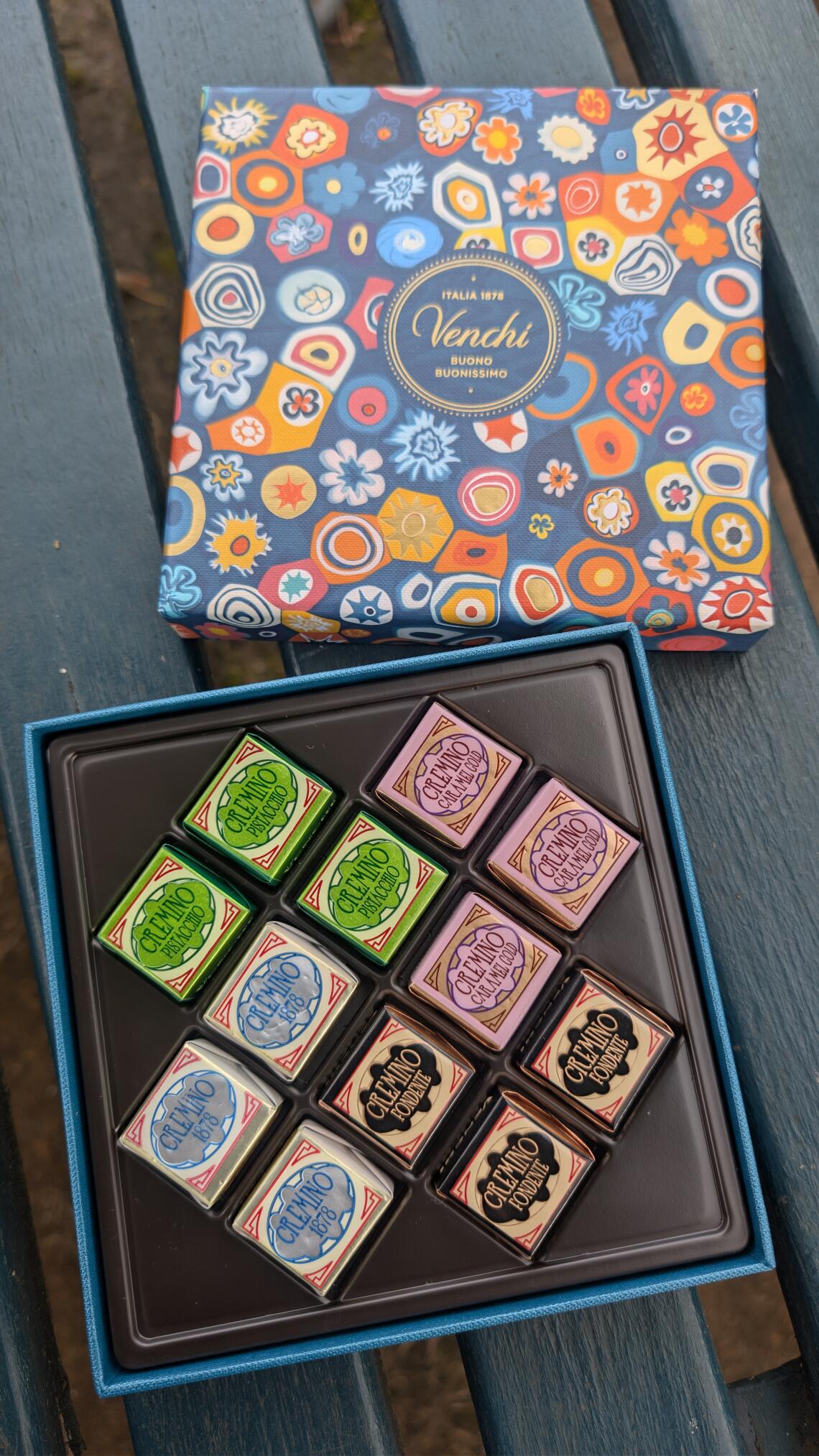
If you want to bring me chocolate, and I know some of you read these diaries with a gift list forming in your heads, and I know this because you've told me, and I find this charming, bring me European chocolate. Venchi is a good choice if you don't know where to get proper French or Swiss chocolate.
Bring me that; let's share and taste geography and time and someone's life's work compressed into two bites, and be very quiet for a moment, and the moment will be worth more than either of us expected.
And then I'll open my eyes and probably say something about how Australian chocolate is fine.
It's fine.
It's just not chocolate.